What Is Speech Therapy, Really? A Guide Every Indian Parent Should Read
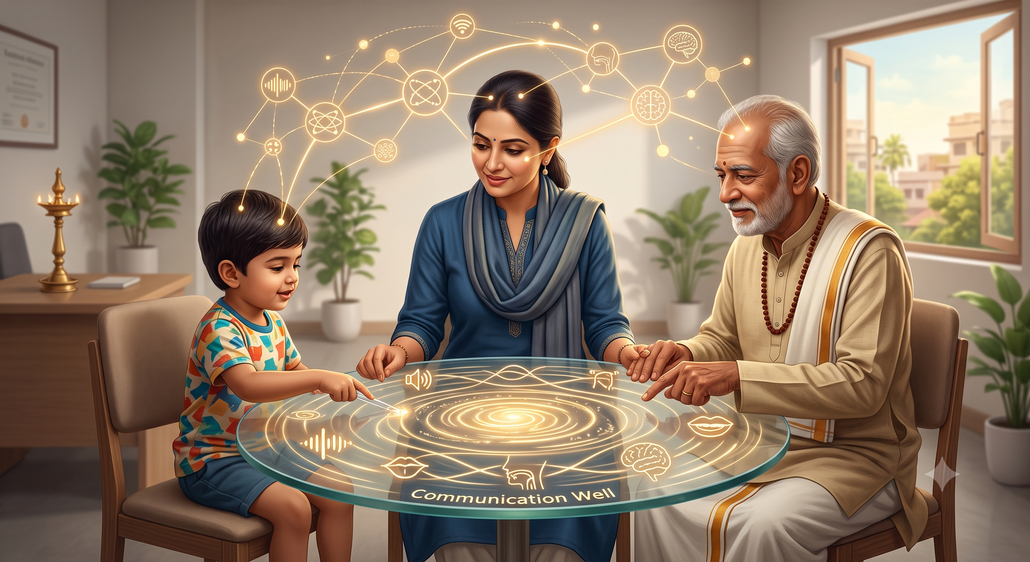
Ask most people what a speech therapist does, and you’ll likely hear: “They help kids who don’t talk.” It’s not wrong — but it’s only a fraction of the picture. Speech therapy is a far broader, more fascinating field that touches voices, brains, accidents, ageing, and the everyday moments that shape how a child learns to communicate. If you’ve ever wondered what really happens behind the term “speech therapy,” this is for you.
It’s Not Just About Children
Speech-language pathologists work with people of all ages. Take voice disorders, for instance — singers who need fine-tuning of their vocal technique, or teachers whose voices grow hoarse and strained after years of speaking loudly in classrooms. That familiar “raspy teacher voice” many of us remember from school? It’s often a sign of vocal strain that a speech therapist can actually help correct — not something to simply accept as an occupational hazard.
Then there are neurological cases — someone who has had a stroke, or been in a road traffic accident, often ends up in an ICU with complications that go far beyond physical injury. Some patients struggle with limb movement, some lose the ability to speak entirely, and others can understand everything around them perfectly but simply cannot get the words out. These are exactly the kinds of cases speech therapists step in to diagnose and treat. It’s a long journey, but with consistent, regular therapy, meaningful improvement is very much possible. Chances are, you or someone in your family has crossed paths with a similar situation — which is exactly why awareness about speech therapy matters so much.
The Part Most Parents Relate To: Child Language Disorders
Here’s where it gets especially relevant for parents. Many children have no physical or developmental issue at all — their hearing is fine, they run around and play just like any other child — yet they struggle to express what they want. This is often a child language disorder, and increasingly, it’s linked to something very modern: how much we engage with our children.
In today’s world, where both parents are often working and nuclear families are the norm, meaningful verbal interaction with young children has quietly reduced. Add a screen into the mix — a phone or TV keeping a toddler occupied — and you have a child receiving plenty of visual stimulation, but very little real conversation. Over time, the child doesn’t just fall behind on words; they lose the very motivation to communicate, because they’ve never had to.
Why the First Five Years Matter So Much
This is the part every parent needs to hear: the first five years of a child’s life are a critical window for language development. This is when the brain’s neurological growth for understanding and producing language happens most rapidly — much like how a child naturally learns to stand, then walk, then run, all within those early years. If there’s any delay during this period, early diagnosis and early intervention make an enormous difference to the outcome.
The Takeaway
Speech therapy isn’t just a service for “children who don’t talk” — it’s a specialised field supporting voices, recovery after neurological events, and above all, giving children the best possible start in communication during their most critical years. If you have even the slightest doubt about your child’s speech and language development, don’t wait it out. Reach out to the team at Andhaadhi Rehab — early support today can shape a lifetime of confident communication.
Video Link: What is Speech therapy -Tamil Part 1| பேச்சுப் பயிற்சி என்றால் என்ன? பாகம் 1


Leave a Reply
Want to join the discussion?Feel free to contribute!