
3 Simple Strategies to Boost Your Child’s Speech and Language Development
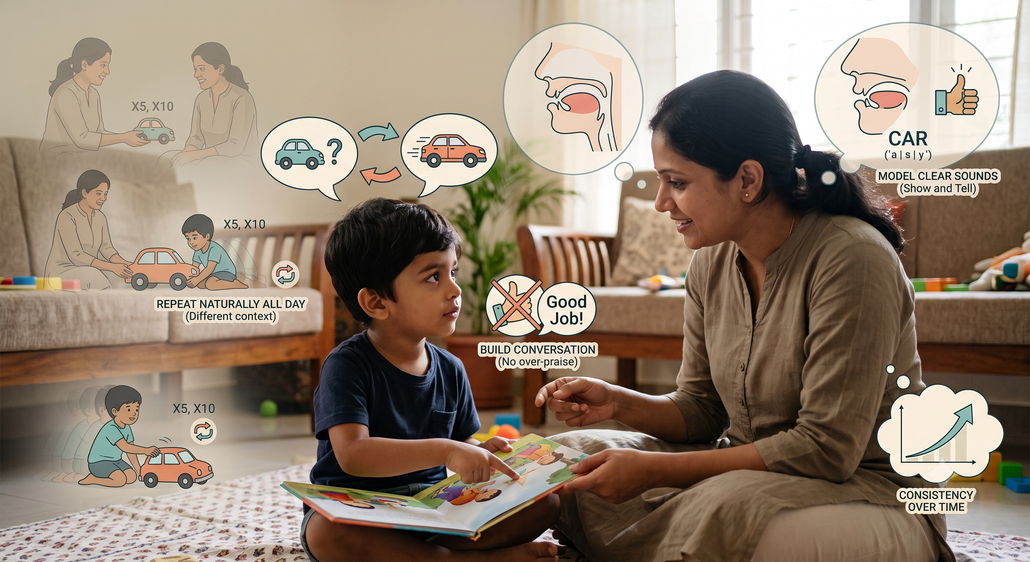
“What can I do at home to help my child speak better?” — it’s one of the questions we hear most often from parents. The good news is that you don’t need expensive toys, flashcards, or fancy equipment. With the right approach during everyday moments, you can make a real difference in your child’s speech and language development. Here are three practical, research-based strategies you can start using today.
1. Modeling: Show, Don’t Just Tell
When your child attempts to say a word, the most powerful thing you can do is model it correctly. This means saying the word clearly, with proper mouth movements, at your child’s eye level so they can watch how the sound is formed.
The best part? You don’t need special materials for this. Everyday objects around the house — a bottle, a spoon, a ball — work perfectly well. Songs and rhymes are also wonderful tools for modeling words in a fun, low-pressure way.
One important rule: model without expectation. Your goal is simply to expose your child to the correct word, not to demand an immediate result. Every child progresses at their own pace, and pushing for instant results can create pressure rather than progress.
2. Repetition: Give Words Time to Sink In
Children need to hear a word many times before they truly understand and can reproduce it correctly. This is why repetition matters so much in early language development.
Rather than saying a word once and moving on, repeat it naturally across different situations and contexts throughout the day. And just as with modeling, repeat without expectation — give your child the time they need to process and eventually attempt the word on their own.
3. Quality Interaction: Make Conversations Go Back and Forth
Good speech and language development isn’t just about individual words — it’s about the quality of interaction between you and your child. Aim for conversations that go back and forth, rather than one-sided instructions or questions.
Here’s a tip many parents don’t expect: try not to over-praise. While appreciation feels natural and positive, saying “good job!” too often — or right after your child speaks — can unintentionally signal that the conversation is over, cutting it short. Instead of praising every response, try building on what your child says. If they say “ball,” you might respond with “Yes, a big red ball!” This encourages them to continue engaging rather than ending the exchange.
Small, Consistent Steps Make the Difference
None of these strategies require dramatic changes to your daily routine — just small, intentional shifts in how you talk and play with your child. Consistency is key, and results often build gradually over time rather than overnight.
If you’d like personalised guidance, hands-on demonstrations, and expert support tailored to your child’s needs, our team at Andhaadhi Rehab regularly conducts parent workshops and one-on-one sessions covering these strategies and more, in both English and Tamil. Reach out to us to learn how we can support your child’s speech and language journey.
Video Link: How to teach your child to Speak? 3 TIPS by Speech therapist in Tamil



Leave a Reply
Want to join the discussion?Feel free to contribute!