Autism or Speech Delay? Understanding the Real Differences
“Does my child have autism, or is this just a speech delay?” This is one of the first questions parents ask when they notice their child isn’t talking as expected. With so much conflicting information on social media, it’s easy to feel confused or anxious. The truth is, autism and speech delay (often referred to as Developmental Language Disorder, or DLD) can look similar on the surface, but they are quite different conditions — and knowing the distinction helps you seek the right support sooner. Please note: this article is meant purely for awareness. It cannot replace a professional evaluation of your child.
Eye Contact
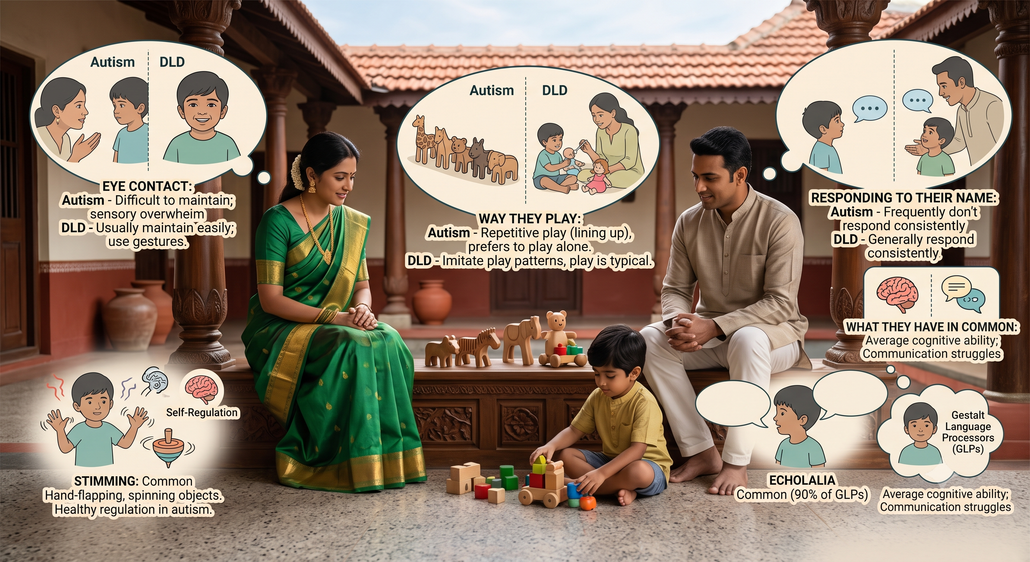
One of the earliest differences to observe is eye contact. Children with autism often find it difficult to maintain eye contact — not because they aren’t listening or responding, but because of sensory overwhelm. This isn’t a flaw; it’s simply how their sensory system processes the world. Children with DLD, on the other hand, usually maintain eye contact easily and use gestures well, even though they struggle to express themselves through words.
The Way They Play
Play reveals a great deal about a child’s development. Autistic children often show repetitive play patterns — lining up toys, repeating the same action (like sliding a toy back and forth) for long stretches, and preferring to play alone based on their sensory preferences, whether visual, auditory, or otherwise. Children with DLD, however, tend to imitate the play they see around them, and their play patterns don’t differ much from typically developing children.
Responding to Their Name
By around one year of age, most children respond when their name is called — it’s an important developmental milestone. Autistic children frequently don’t respond consistently to their name, while children with speech delay generally do.
Stimming
Stimming refers to self-stimulatory, soothing behaviours such as hand-flapping, spinning objects, repeatedly opening and closing things, or repeating the same sound or phrase. It’s a healthy way for autistic children to self-regulate and is commonly seen in autism, but rarely in typically developing or DLD children.
Echolalia
Echolalia is the repetition of words or sentences exactly as heard, instead of forming an original response. It appears in around 90% of autistic individuals and is far less common in children with speech delay alone. Children who show echolalia are often described as Gestalt Language Processors (GLPs), and they benefit greatly from therapists trained specifically in Gestalt Language Processing approaches.
What They Have in Common
Despite these differences, autistic children and children with DLD share some similarities — both typically have average to good cognitive ability, and both experience genuine difficulty with communication, whether in expressing themselves, understanding language, or socializing.
The Most Important Step: Early Support
Whether your child shows signs of autism, speech delay, or both, early identification and early intervention make all the difference. At Andhaadhi Rehab, our team of speech therapists, occupational therapists, and special educators — including specialists trained in Gestalt Language Processing — offer online, home-based support tailored to your child’s needs. If you have any doubts, don’t wait; reach out to us for guidance.
Video Link: Autism OR Speech delay – 6 STRIKING DIFFERENCES | Speech therapy


Leave a Reply
Want to join the discussion?Feel free to contribute!